

Virtual Assistant Agency vs. Freelancer vs. Employee: Which Support Model Fits Your Business?

Your calendar is full. Your inbox is overflowing. And the work that could grow your business keeps getting pushed to tomorrow.
The right support can give you room to move forward. But choosing a virtual assistant agency, freelancer, or employee takes more than comparing rates. You also need to consider who manages the work, how much support you need, and how closely that person needs to work with your team.
Today, we’ll compare all three models to help you choose the support that fits your workload, budget, and management capacity.
Key Takeaways
- An agency’s value lies in its service: Look for recruiting, matching, and ongoing support that meaningfully reduce your management burden.
- A freelancer offers a direct relationship: A strong fit for clearly scoped projects or recurring work when you can manage the engagement.
- An employee builds internal capability: Consider this model when sustained responsibilities require deep business knowledge and close team integration.
- Compare the full cost of effective support: Include onboarding, coordination, and coverage alongside fees or pay, and measure how much time you actually reclaim.
Agency vs. Freelancer vs. Employee: The Key Differences
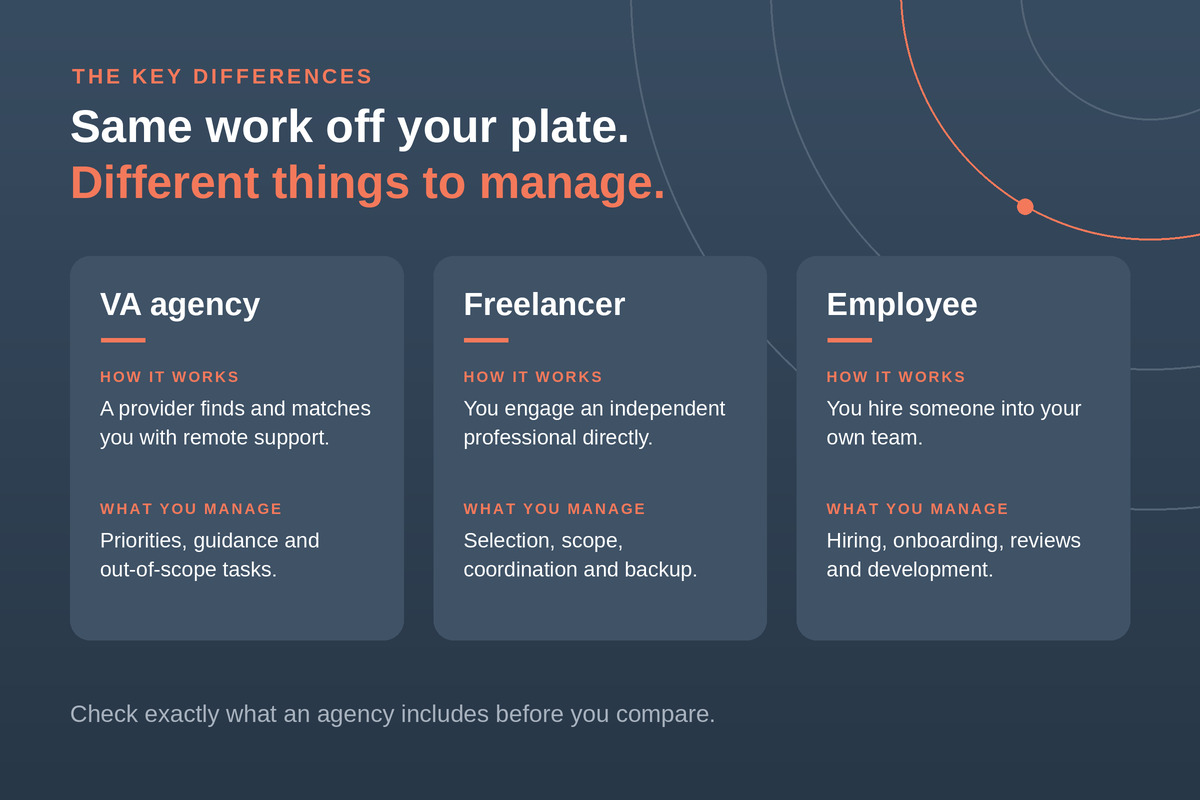
All three models can take work off your plate. The key difference is how you hire support and how much responsibility stays with your business.
| Model | How it works | What you manage |
| VA agency | A provider finds and matches you with remote support. | Priorities, business-specific guidance, and duties outside the service agreement. |
| Freelance | You engage an independent professional directly. | Selection, scope, coordination, feedback, and backup arrangements. |
| Employee | You hire someone into your team. | Recruitment, onboarding, performance, development, and employment responsibilities. |
Employees can work remotely or part time, while freelancers can provide ongoing support.
Agency services also vary: some include ongoing support, while placement-only services leave management with you after the hire. Check exactly what’s included before comparing options.
When Each Support Model Makes Sense
The right support can clear your calendar, keep essential work moving, and give you room to grow. Here’s when an agency, freelancer, or employee best fits your workload and the management responsibility you can take on.
VA Agency: When the Service Layer Matters
A VA agency can be a strong fit when you need recurring administrative support and have limited time to recruit. Its value comes from the hiring and service responsibilities it handles for you.
Depending on the package, that may include sourcing, screening, matching, onboarding assistance, and ongoing account support.
Before committing, confirm:
- Whether your assistant is dedicated or shared, and what onboarding includes.
- Who handles service concerns, absences, and replacement requests.
- What minimum hours, scope limits, and cancellation terms apply.
You still need to explain your business, set priorities, and give feedback. Check the agreement carefully so you know which management duties remain with you.
Imagine a founder spending evenings managing emails, scheduling meetings, and chasing client follow-ups. An agency could help them find suitable support and provide a contact when the arrangement needs adjustment.
The fee earns its value when those services reduce the founder’s workload.
Freelancer: When You Have a Clear Scope and Can Manage the Relationship
Choose a freelancer when you can define the work, select someone with relevant experience, and manage the engagement directly.
This works for both a single project and ongoing support. You might hire a specialist to clean up your customer relationship management (CRM) system, then agree on a monthly retainer to keep records accurate.
The benefit is a direct relationship built around an agreed scope. Flexibility depends on the professional’s availability and engagement terms.
Set expectations early:
- Define deliverables, quality standards, and how you’ll review results.
- Agree on response times, overlapping work hours, and scope changes.
- Document the work and arrange cover for absences or departure.
You own the brief, priorities, and coordination. A capable freelancer can work independently, but they need enough context to make sound decisions.
For example, a business with a documented CRM process could engage a freelancer for weekly maintenance. The arrangement fits because responsibilities are clear and someone internally can review outcomes.
That clarity helps both sides work effectively.
Employee: When You Need an Integrated Internal Role
An employee can be a strong fit when support has become a sustained internal role with responsibilities that evolve alongside your business.
Think beyond a task list. The role may involve coordinating departments, handling changing priorities, and using knowledge of your customers, systems, and team to make daily decisions.
Over time, an employee can build context that makes those responsibilities easier to manage. That value grows through clear onboarding, feedback, and development.
Plan for:
- A realistic workload and clearly defined responsibilities.
- Recruitment, relevant employment costs, equipment, and development.
- Ongoing management, performance reviews, and absence coverage.
Employment can also be part time or remote. Choose hours and location around the role’s actual requirements.
For example, a growing business might need an administrator to coordinate client handovers, internal meetings, and follow-ups across sales and delivery teams. An employee could become the consistent internal contact for that work.
The deciding factor is whether you need ongoing internal ownership and can support the role sustainably. Business size alone does not settle the choice.
Compare Total Cost, Including Your Management Time
The quoted rate is only part of what you’ll pay. Your time matters too, especially if the arrangement leaves you chasing updates or correcting work.
Start by comparing the same workload, skill level, response expectations, and coverage window. A few hours of scheduled administration and availability throughout the working day are different requirements.
Then account for:
- Direct payments: Agency fees, freelance charges, or employee pay.
- Getting started: Recruitment, screening, onboarding, and training.
- Running costs: Tools, equipment, and relevant employment costs.
- Your time: Briefing, coordination, feedback, and rework.
- Continuity: Absence coverage, replacement, and handover arrangements.
Separate startup costs from ongoing effort. Initial training takes time in every model; assess whether coordination becomes manageable once the person understands the work.
A lower rate can involve more oversight. A higher fee earns its value when the included services reduce your workload or improve delivery.
Use this practical measure:
Net time reclaimed = hours of work transferred − hours spent on ongoing coordination and rework.
For example, transferring eight hours of work while spending three hours managing it gives you five hours back. Track quality and responsiveness alongside that figure.

This reflects Dan Martell’s focus on reclaiming time: evaluate support by the capacity it creates for more valuable work.

Choose the Model That Fits the Work You Need Done
Your next hire should solve a defined business need. Before choosing the arrangement, look closely at the work you want to hand over.
Review two representative weeks of tasks. Record their frequency, time requirements, necessary skills, and decisions requiring your input. This combines Boudreau and Jesuthasan’s focus on individual tasks with Chris Ducker’s guidance on hiring for a defined role.
Then ask four questions:
- How consistent is the workload? Separate recurring responsibilities from occasional projects.
- Do the tasks form one realistic role? Group related work and identify where specialist skills are needed.
- Who will manage the support? Name the person responsible for priorities, feedback, and continuity.
- How much business context is required? Consider coordination across teams and ongoing decision responsibility.
Use your answers to build a shortlist:
- Consider an agency when its recruiting and service support address a real management need.
- Consider a freelancer when a direct engagement suits the scope and you can manage the relationship.
- Consider an employee when the work justifies an ongoing internal role.
Different responsibilities may suit different models, so a combined approach can also make sense.
Turn your findings into a brief covering responsibilities, availability, success measures, budget, and management expectations.
Bring that brief to your next hiring conversation. Ask candidates or providers how they would deliver the outcomes, and what responsibilities would remain with you.
Frequently Asked Questions
Can I Start With Just a Few Hours of Support Each Week?
Yes, provided the role and engagement terms suit a smaller commitment. Check agency minimums, freelance project or retainer options, and whether part-time employment is practical. Agree separately on response times: five hours of work does not mean availability throughout the week.
Is a VA Agency Cheaper Than Hiring an Employee?
The cheaper option depends on workload, skills, availability, and service terms. Compare equivalent support, including agency fees or employee pay, recruitment, tools, relevant employment costs, and management time. A lower quoted price alone does not establish better value.
Does a VA Agency Manage the Assistant for Me?
Management responsibilities depend on the agency’s agreement. Some offer ongoing support or oversight; placement-only services generally leave management with you. Confirm who sets daily priorities, provides training, reviews performance, and handles service issues before committing.
What Happens if My Assistant Is Unavailable?
Your absence plan should identify who handles urgent work. Document essential processes and arrange appropriate backup access before support begins. For an agency, check whether temporary coverage or replacement is included and how quickly it can be arranged.
Can I Change Support Models as My Business Grows?
Yes. Reassess your arrangement when workload, responsibilities, or management capacity change. Review existing engagement terms, document processes, and allow time for a structured handover. Make clear who owns each responsibility during the transition and how access will transfer.